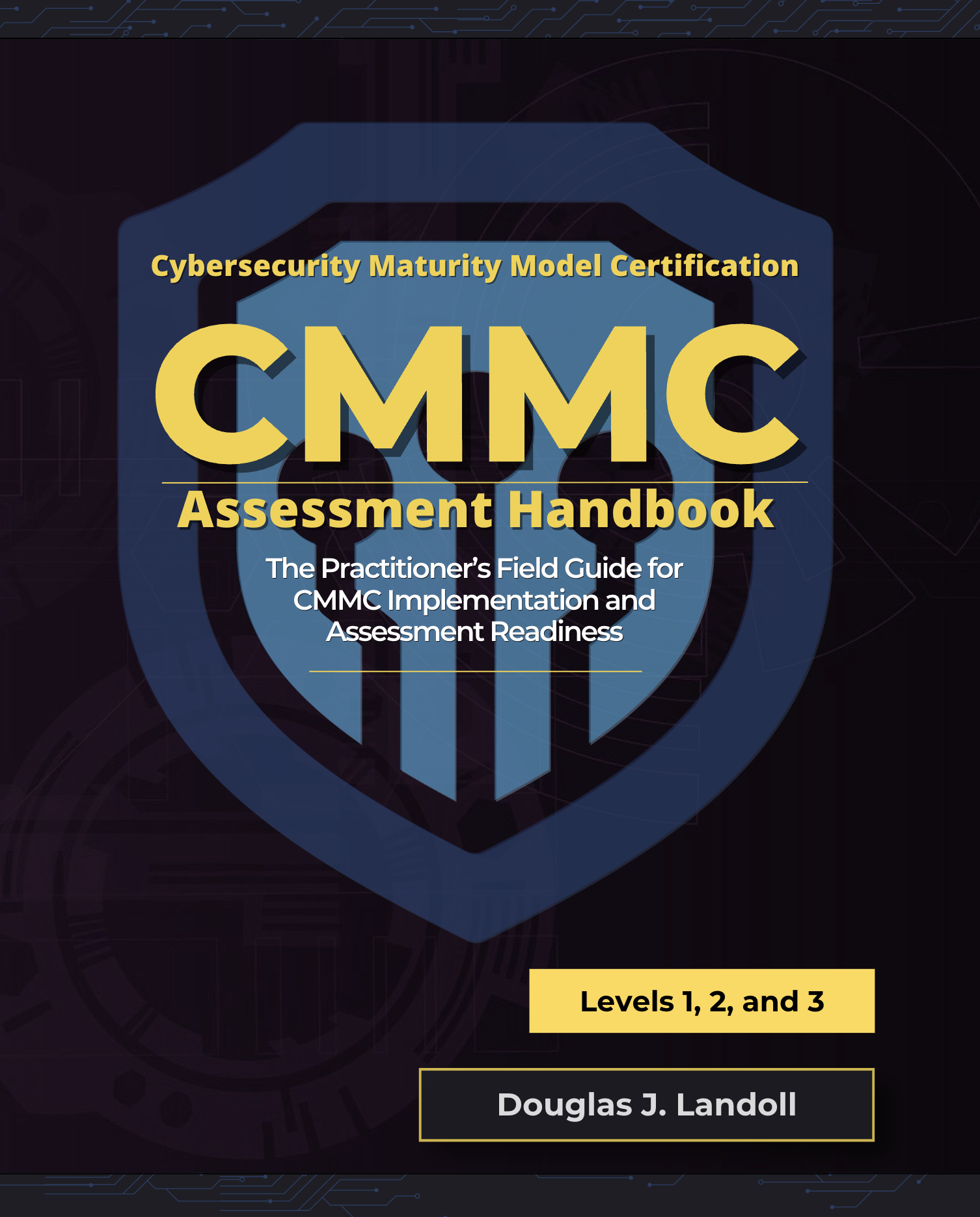
Cybersecurity Maturity Model Certification
CMMC
Assessment Handbook
The Practitioner’s Field Guide for CMMC Implementation and Assessment Readiness
Updated June 2026
CMMC is no longer a future concern. Defense contractors must be able to demonstrate that required cybersecurity controls are implemented, documented, assessed, and supported by credible evidence.
The CMMC Assessment Handbook – Final Rule Edition has been comprehensively revised and expanded through real-world field work helping organizations implement controls, close gaps, prepare evidence, and build assessment-ready cybersecurity programs.
This edition provides a structured roadmap for CMMC Levels 1, 2, and 3. Whether you are building an enclave, refining policies and procedures, managing remediation activities, or preparing for a C3PAO assessment, this handbook translates complex federal requirements into practical implementation and assessment-readiness guidance.
This is So Much More Than a Requirements Guide
This is not a short summary of CMMC requirements. It is a detailed practitioner's field guide designed to help readers understand what the requirements mean, how they are commonly implemented, what evidence may support them, and where organizations often encounter challenges during assessment preparation.
Throughout the book, every requirement is supported by practical implementation guidance, including:
Implementation Strategy – Practical guidance that translates regulatory language into operational, administrative, and technical implementation considerations.
Gut Check Questions – Readiness questions that help organizations evaluate whether controls are operating effectively and whether they are prepared to demonstrate compliance during an assessment.
Practitioner’s Playbook – Real-world implementation insights, recommendations, and lessons learned drawn from actual implementation and assessment experience.
Common Pitfalls – Frequent implementation mistakes, evidence gaps, and operational weaknesses that can increase risk or create assessment findings.
Examples and Insights – Supplemental examples, scenarios, diagrams, and implementation references that help clarify complex technical and operational concepts.
Inside This Expanded Edition
Requirement Guidance – Understand CMMC requirements, assessment objectives, implementation expectations, and evidence considerations.
Evidence Readiness – Organize documentation, technical settings, operational records, provider evidence, SSP updates, and remediation closure evidence.
Shared Responsibilities – Address supplier management, external service providers, inherited controls, and complex boundary decisions.
Assessment Preparation – Prepare personnel, documentation, and evidence for formal assessments.
Sustained Compliance – Build repeatable processes that help maintain cybersecurity readiness after certification.
Written for defense contractors, consultants, cybersecurity professionals, system administrators, and compliance teams, this handbook functions as both a reference manual and a practical working guide.
Whether you are responsible for implementing CMMC, managing DFARS 252.204-7012 obligations, preparing for assessment, or supporting organizations across the Defense Industrial Base, this expanded edition provides the practical guidance needed to protect CUI, support contract eligibility, and approach CMMC assessment with confidence.
cmmc assessment handbook
final rule edition

free cmmc downloads


douglas landoll
Douglas Landoll has over 37 years of information security experience. He has led security risk assessments establishing security programs within top corporations and government agencies. He is an expert in security risk assessment, security risk management, security criteria/compliance and building corporate security programs.
As a senior analyst at NSA, Mr. Landoll was responsible for evaluating security for NATO, the CIA, DoD, FBI and other government agencies. He co-founded the Arca Common Criteria Testing Laboratory, and co-authored the Systems Security Engineering - Capability Maturity Model (SSE-CMM - ISO 21827), taught at NSA's National Cryptologic School, and ran Exodus Communications' southwest security services division. Landoll has led security risk assessments and established security programs within top corporations and government agencies. He is an expert in security risk assessment, management, criteria, and building corporate security programs.
Mr. Landoll has served as the Practice Director for Risk and Compliance Management at Accuvant (now Optiv), the founder and president of Veridyn Inc. prior to their acquisition by En Pointe Technologies and the founder of Lantego Security. He also holds a CISSP and a Computer Science degree from James Madison University, and an MBA from the University of Texas, Austin. Mr. Landoll has published dozens of information security articles, speaks regularly at conferences, and serves as an advisor for several high-tech companies.
